Arrive with meetings.
Leave with next steps.
Start about 60 days before the event.
Pick your 10
Choose 10 must-meet accounts. Find the right buyers. Check who is going.
Speakers · Exhibitors · SponsorsBook the meeting
Reach out. Follow up. Agree on a time and place before you travel.
LinkedIn · Email · Phone · Event appHave a call first
Learn their problem. Agree what to discuss. Make the event meeting count.
Intro call → Useful in-person meetingStay familiar.
Move the deal forward.
Track the next step.
Your first move today: write down your Top 10.
Start with a target of 5 relevant meetings. Adjust for event cost and team capacity. Bookings are a planning target, not guaranteed sales.
Before you book the flight, build the meeting list.
Start buyer outreach about 60 days before the event. Pick 10 must-meet accounts. Try to have the first sales call before you arrive, so the conference meeting can move the deal forward.
Your booth already has a budget. Give your meeting plan one too.
The question is simple: how do you arrive at a B2B conference with relevant buyer meetings already booked?
Here are the three steps I use, followed by a checklist you can use for your next event.
1. Start pre-event outreach about two months early
Waiting for the attendee list can leave you with very little time.
In the video, I explain why I prefer roughly two months: connecting with people, setting up the outreach and following up can take weeks. A seven-day gap between messages quickly eats into a short window.
Start with the sources you can already access:
- Speakers on the official event website.
- Exhibitors and sponsors.
- Previous-year attendees you already know.
- People publicly discussing this year’s event.
Companies can also aim to be included in relevant event guides, such as TechCurrent’s event guides. Share clear product details and confirmed event participation so editors can assess whether the company fits their coverage.
These are starting points for research. Someone who attended last year may skip this year. A sponsor’s employee may work from home while a colleague attends. Check the person’s role, fit and current attendance before making an event-specific claim.
When the event app opens, add it to the outreach plan. The timing varies by event, so check the organizer’s schedule.
Use five relevant buyer meetings as a starting target. Adjust it for your deal value, travel cost and how many meetings your team can handle. Five good conversations can be more useful than a packed calendar of poor-fit contacts.
2. Build your Top 10 Must-Meet Accounts list
Your wider list helps fill the calendar. Your Top 10 tells you where to spend your best effort.
Choose companies where a good sales opportunity could justify the event spend. For each account, write down:
- The company and the person you want to meet.
- Why they fit your offer.
- One useful reason for them to speak with you.
- What you know about their attendance, with a source.
- The best way to reach them and the next action.
Use LinkedIn, email, phone and the event app where appropriate. Keep one shared record so your team can see replies and avoid repeating the same ask across channels.
Even if a meeting is still unconfirmed, the list gives you a plan on the floor. You know which company matters, who to look for and what to discuss.
“I saw your team is exhibiting. We help companies with [specific problem]” gives a buyer more context than another “we are an AI-powered platform” introduction.
A simple first message
Use this only after you have checked the event detail and the buyer’s fit:
Hi [Name], saw [Company] is exhibiting at [Event]. We help [type of company] with [specific problem]. Worth a short call before the event to see if a meeting there would be useful?
Replace each bracket with a checked fact. Have a person review the message before sending it. If attendance is unknown, ask whether they are going instead of claiming they will be there.
3. Have the first sales call before the conference
This is the step that can make the event meeting much more useful.
Once someone agrees to meet at the conference, offer a short intro call beforehand. On that call, learn what they are working on, check whether you can help and agree on what to cover in person.
The flow becomes:
Outreach → Intro call → Conference meeting → Agreed next sales step.
At the event, you can discuss the buyer’s situation, a relevant example or a possible next step. You have already covered the basic introduction.
For a short sales cycle, a deal may move quickly. For a longer one, progress might mean agreeing on a demo, a technical discussion or a meeting with another decision-maker. Pick the next step that fits the buyer.
If they prefer to meet only at the event, keep the confirmed slot. The early call should make the meeting easier, not add a hurdle.
What this looked like at AI4
Our published Shivaami AI4 case study records 25 meetings booked against a target of 10. The attendance tracker separately records 18 booth visits: 12 scheduled prospects and six additional warm visitors.
The campaign ran across roughly a month. That shows what happened in this campaign; two months is my preferred planning window for a future event.
These figures do not establish closed revenue or financial ROI. Read the AI4 case study, evidence and limits.
What BizAmps offers for your next conference
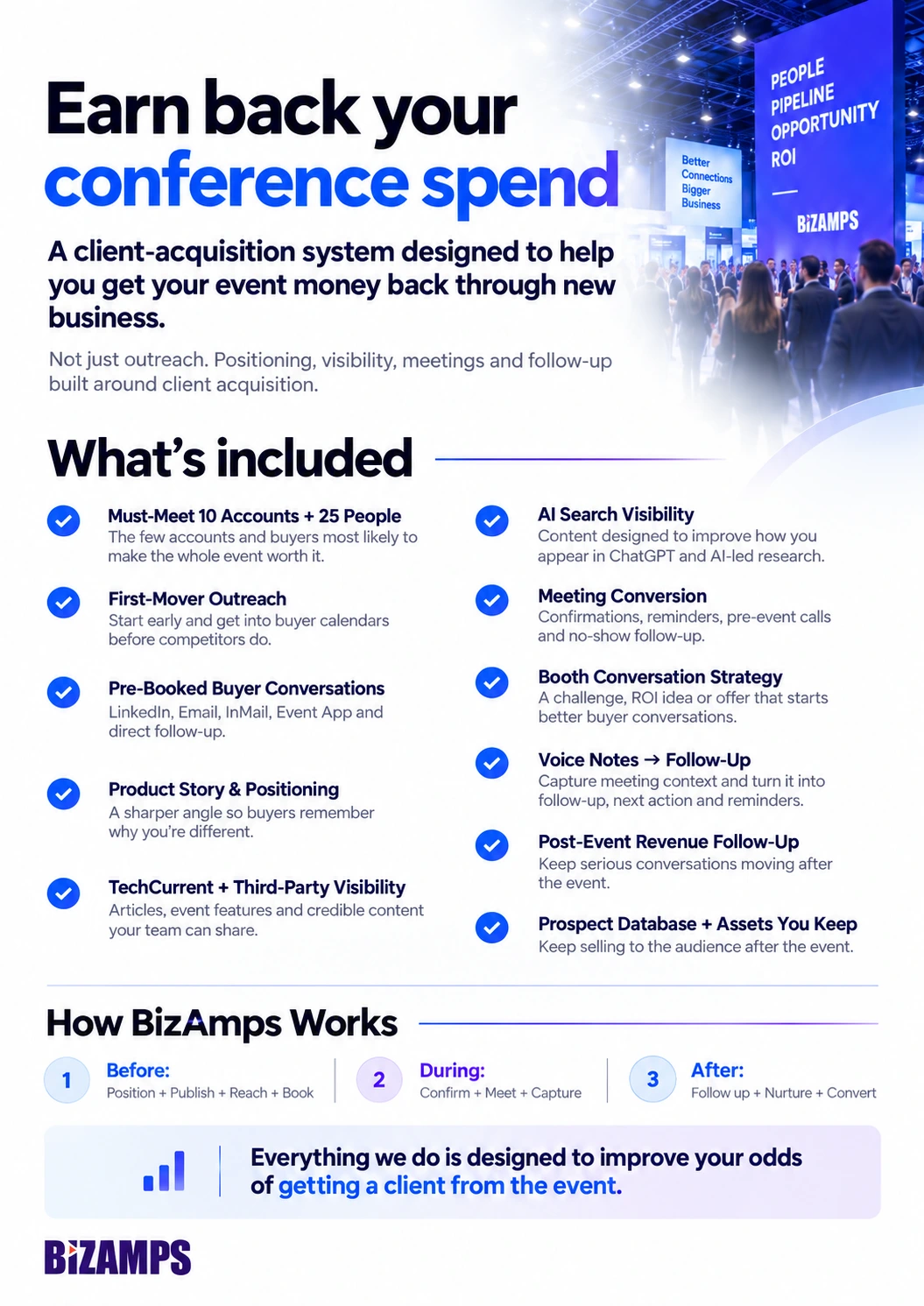
We help with the work before, during and after the event: choosing must-meet accounts, outreach, booking, positioning, visibility and sales follow-up.
Keep the sales team working during the event
A calendar booking still needs coordination. People miss slots, lose track of time or struggle to find the booth.
Give someone on your team responsibility for meeting reminders and replies while the people at the venue focus on conversations.
- Confirm the time and exact location with booked prospects.
- Give interested contacts a clear way to find your team.
- If you have a speaking slot, share the topic, time and stage with relevant contacts that morning.
- Record who arrived, who missed the meeting and what each person agreed to do next.
Use a useful case study or event-specific article before the event to help buyers understand your offer. During the event, keep messages short and timely. A clear location beats a long pitch when someone is walking between sessions.
Your 60-day conference outreach checklist
Treat this as a planning guide. Move the dates to match the event app, your sales cycle and your team’s capacity.
- About 60 days before: Check buyer fit. Build the first target list and Top 10 accounts. Start outreach.
- As the app opens: Add verified attendees. Use replies from earlier outreach to guide the next messages.
- Two to four weeks before: Turn interest into confirmed slots. Offer intro calls and share relevant proof.
- Event week: Confirm time, location and who owns each meeting. Make sure the sales team has the account notes.
- At the event: Meet priority accounts, coordinate arrivals and record the agreed next step.
- After the event: Follow up based on the conversation. Separate attended meetings, missed meetings and new warm contacts.
Keep the tracking simple: account, buyer, attendance evidence, meeting status, owner, next action and due date.
Measure more than meetings booked
To understand conference ROI, track the steps separately:
- Relevant meetings booked.
- Meetings that actually happened.
- Qualified opportunities created or advanced.
- Deals won and the gross profit they produced.
- Total event and outreach cost.
Pipeline can help you judge early progress. Financial ROI needs a defined time period, a clear way to credit the event and actual financial results.
Ten calendar invites alone cannot answer whether the event paid for itself.
FAQ
How early should conference outreach start?
Plan to start about 60 days before an important event. That gives you time for research, contact, follow-up, booking and an intro call. Use the event app when it opens; the date varies by event.
Can I book meetings without an attendee list?
Yes. Start with speakers, exhibitors, sponsors, past attendees and public event discussions. Confirm current attendance before calling someone an attendee.
How many meetings should I book?
Use five relevant buyer meetings as a starting target. Choose the final number based on deal value, event cost and team capacity. A booking is separate from attendance and a sale.
Do I need a booth?
No. Agree on a clear meeting location, such as a venue cafe or meeting area. The core work is choosing accounts, booking meetings and agreeing on next actions.
Put the meeting plan next to the event budget.
For your next conference, write down the Top 10 accounts, the meeting target and who owns outreach. Then use the checklist above to work back from the event date.
Need help with an upcoming event? Talk to BizAmps about your conference plan.